CONVENIENTLY LOCATED FOR FAIRFIELD COUNTY & WESTCHESTER PATIENTS
After a mastectomy, many women feel an overwhelming sense of loss—not just physically, but emotionally. The journey to reclaiming your body and confidence doesn’t have to be uncertain. With advances in modern surgical techniques, breast reconstruction offers women multiple pathways to restore their silhouette and sense of self.
Dr. Elsa Raskin has spent over two decades perfecting her approach to breast reconstruction, earning recognition as a Top Doctor for her commitment to natural-looking results and compassionate care. Her expertise and dedication to each patient’s unique goals ensure you’ll receive a treatment plan tailored specifically to help you feel whole again.
WHAT IS BREAST RECONSTRUCTION SURGERY?
For women who have undergone a mastectomy due to breast cancer, breast reconstruction surgery is a way to help them rebuild their breasts and regain their self-confidence as a woman. It is typically performed on women who have recently had a mastectomy and have a low-level risk of recurrence.
TYPES OF BREAST RECONSTRUCTION SURGERY
- TISSUE EXPANSION – During this procedure, a balloon expander is placed underneath the chest muscle. The balloon is slowly injected with the salt-water solution that expands the balloon and stretches the skin. This expansion occurs over several weeks or months. Once the area is adequately stretched, the balloon expander is replaced with a permanent saline or silicone implant, though sometimes the balloon expander is left as the final implant. The nipple and areola are then reconstructed. This procedure has the fastest recovery time, but it requires several office visits for expansion, meaning it could be weeks until a proper breast mound forms.
- TRAM FLAP AND LATISSIMUS FLAP RECONSTRUCTION – Flap breast reconstruction surgeries use either the soft tissue from the lower abdomen (TRAM Flap) or soft tissue from the back (Latissimus Flap) to create a skin tissue flap to place underneath the chest skin to create space for an implant. Occasionally the flap of tissue (which consists of skin, muscle, and fat) forms a breast mound, making an implant unnecessary. This surgery has a longer recovery time and causes discomfort in areas other than the breast; however, a proper breast mound is seen immediately after surgery.
- PREPECTORAL BREAST RECONSTRUCTION AND FAT GRAFTING – Prepectoral breast implant reconstruction is the current state-of-the-art method of implant-based breast reconstruction. Prepectoral breast reconstruction restores the shape of the breast using an implant placed directly into the space created by mastectomy. Without disturbing the pectoralis muscle, a silicone-filled implant wrapped in specialized material known as acellular dermal matrix is inserted immediately following mastectomy. Prepectoral reconstruction avoids the weakness and discomfort, and implants placed on top of the muscle do not flex or become distorted with pectoralis muscle flexion, upper body movements, or exercise. Therefore, the unnatural movement and distortion of implants that is commonly seen when “under-the-muscle” implant reconstruction patients move their upper bodies or exercise (known as “muscle flex deformity” or “dynamic distortion”) is avoided. A second stage surgery using your own fat can be added a few months later to soften the edges of the implants and give you a more natural appearance.
PHOTO GALLERY
View before-and-after pictures of real patients of Dr. Elsa Raskin
Before
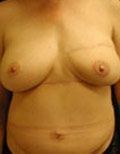
After
Most of these surgeries require a series of periodic procedures as well as follow-up surgeries. Dr. Elsa Raskin can help determine which breast reconstruction option is best for you.
RISKS OF BREAST RECONSTRUCTION SURGERY
Like all surgical procedures, breast reconstruction surgeries come with potential risks. These risks include excessive bleeding, excessive scar tissue, adverse reaction to anesthesia, and infection. In cases of infection, a breast implant will need to be removed until the infection clears. The most common issue from breast reconstruction surgery is capsular contracture, which happens when the scar around the implant begins to tighten, causing the breast to feel hard. This surgery has no known effect on breast cancer recurrence, and it does not tend to interfere with chemotherapy or radiation treatment should cancer recur.
POST-OP AND RECOVERY
After your breast reconstruction, small drainage tubes may need to be inserted into each breast. The surgical dressing will be removed within a few days, and sutures should dissolve on their own in about a week. Swelling typically lasts for about three to five weeks, or for three to five months if implants were placed under the chest muscle. During the first two weeks after your procedure, you may experience a burning sensation in your nipples. Patients usually can return to work after a few days but are encouraged to avoid any strenuous activity for about two to three weeks. Scarring will occur with breast augmentation, but it will fade over time.
“I WOULD HAPPILY BE THEIR PATIENT AGAIN.”

Dr. Elsa Raskin is fabulous! An incredibly talented plastic surgeon who is warm, welcoming, and kind. She (as well as her wonderful team, Kathleen and Marisa) made sure my surgery experience from start to finish was easy, pleasant, and painless, and the improvement to my appearance is just as promised…a new, refreshed me! Thank you so much for everything, and I am sure I will be returning very soon!
RISKS OF BREAST RECONSTRUCTION
Like all surgical procedures, breast augmentation comes with potential risks. These risks include excessive bleeding, adverse reaction to anesthesia, infection, or oversensitive, undersensitive, or numb nipples. The most common issue from breast reconstruction surgery is capsular contracture, which happens when the scar around the implant begins to tighten, causing the breast to feel hard. There is a chance that the implant will break, which will require a second operation to replace the leaking implant. There is no evidence connecting breast implants with cancer, arthritis-like conditions, or immune system diseases. Breast implants may affect how a mammogram is performed, but trained radiologists can use a special displacement technique to obtain an accurate mammogram.
WHY CHOOSE DR. ELSA RASKIN FOR BREAST RECONSTRUCTION IN GREENWICH, CT?
Dr. Elsa Raskin brings over two decades of surgical expertise and board certification in plastic surgery to every breast reconstruction case. As a Top Doctor recognized by Greenwich Magazine for 10 consecutive years, she has earned the trust of countless patients through her commitment to natural-looking results and personalized care.
Dr. Raskin’s approach combines advanced surgical techniques with meticulous attention to detail, ensuring each patient’s unique aesthetic goals guide their treatment plan. Her compassionate demeanor and skilled staff create a supportive environment where patients feel heard and valued throughout their reconstructive journey.
SCHEDULE A CONSULTATION TODAY
Ready to restore your confidence with expert breast reconstruction? Call Dr. Raskin’s practice today at 203-861-6620 to schedule your personalized consultation.
Our compassionate team will answer all your questions and discuss your unique goals. Don’t wait—contact us now to begin your path toward recovery and renewed self-assurance.
