Implant sizing: Dr. Raskin prioritizes preserving your natural breast tissue. She selects implants with a diameter smaller than your natural breast width and a volume no greater than your existing breast volume. These guidelines help limit pressure on breast tissue and support natural proportions.
Fat transfer: For modest enlargement, Dr. Raskin may use your own fat instead of implants or combine fat transfer with smaller implants. She advises that approximately 50% of transferred fat may be reabsorbed during the first six months, although individual results vary. Risks include fat necrosis and cyst formation.
Incision technique: Dr. Raskin generally prefers an incision beneath the breast crease. She may use an incision around the areola when combining augmentation with a breast lift.
Pain management: Her non-opioid pain-control protocol includes Marcaine anesthetic blocks and medication such as JOURNAVX to reduce postoperative discomfort.
Recovery and follow-up: Dr. Raskin typically sees you two days after surgery, followed by regular visits during the first two months and additional evaluations at six months and one year.
Dr. Raskin is board-certified by the American Board of Plastic Surgery. She has practiced since 2001 and completed plastic surgery training at New York Presbyterian Hospital. She considers your breast measurements, skin, and desired changes when recommending surgery.
Breast Implant Options and Placement
Silicone implants contain a cohesive gel, while saline implants hold sterile saltwater. Both are placed through an incision, usually in the crease beneath your breast. Depending on your tissue coverage, Dr. Raskin may position implants above or beneath the chest muscle. During your visit, our gel sizers can help you estimate potential proportions.
Why Implant Size Matters
Dr. Raskin believes an implant should work with your existing tissue, not overpower it. Her sizing principles are to keep the implant diameter smaller than your breast width and its volume at or below your natural breast volume.
Oversized implants can place lasting pressure on breast tissue, potentially causing thinning, visible implant edges, or an overly firm appearance.
PHOTO GALLERY
Before
After
Before
After
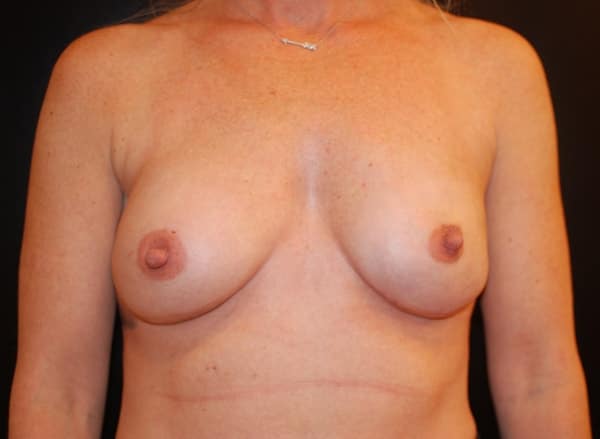
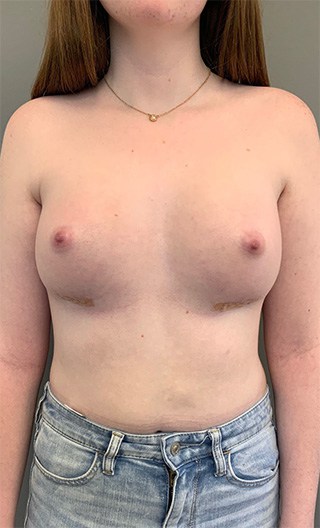
The following images contain nudity. User discretion is advised.
Fat Transfer and Combination Augmentation
Fat transfer augmentation uses liposuction to collect fat from your body, then injects it into your breasts. Dr. Raskin considers this option for patients who want a modest increase and have enough donor fat. She generally limits the amount transferred to each breast to no more than its existing volume. This means fat transfer may not suit patients seeking a larger increase, even when sufficient donor fat is available.
When you have limited natural breast tissue, Dr. Raskin may combine a small implant with fat transfer to add volume and improve soft tissue coverage. She advises that approximately half the injected fat may be reabsorbed during the first six months, although retention varies. Possible complications include fat necrosis, cyst formation, and lumps that may need evaluation.
Breast Augmentation Recovery and Risks
Expect some swelling, bruising, and soreness after surgery. Since early 2026, Dr. Raskin has used a non-opioid pain-management protocol that combines Marcaine anesthetic blocks during surgery with JOURNAVX to help manage postoperative discomfort. Her approach is intended to reduce pain, including for implants placed beneath the chest muscle. She typically checks your healing two days after surgery, then every week or two for the next two months, and again around six months and one year.
Implant risks include infection, altered nipple sensation, capsular contracture, rupture, and possible future surgery. Rare cancers (opens in new tab), including breast implant-associated anaplastic large cell lymphoma (BIA-ALCL) and squamous cell carcinoma (SCC) in the surrounding scar tissue, have also been reported. BIA-ALCL is more closely associated with textured implants, which Dr. Raskin does not use.
Why Choose Dr. Elsa Raskin for Breast Augmentation in Greenwich?
Dr. Raskin performs approximately 50 to 60 breast surgeries annually across different procedures. Rather than pushing for a particular cup size, she assesses tissue volume, implant width, and whether fat grafting can realistically meet your goals. She explains the advantages and drawbacks of each option to help you make an informed decision.
No. Breast implants don’t have a fixed expiration date, but they aren’t lifetime devices. Replacement or removal may become necessary if complications develop or your preferences change. The FDA (opens in new tab) recommends ultrasound or MRI screening for silent rupture beginning five to six years after silicone implant placement and every two to three years thereafter. Dr. Raskin can explain the appropriate monitoring for your implants.
Many women can breastfeed after augmentation, but surgery can affect milk supply, particularly when nerves or milk ducts are disturbed. Tell Dr. Raskin if future breastfeeding matters to you so you can discuss incision and placement options.
In Dr. Raskin’s practice, a mini breast augmentation means adding less than 200 cc of volume using implants or fat. It’s intended for a relatively small increase rather than dramatic enlargement. Your anatomy determines whether it’s suitable.
Yes. Continue recommended breast screening, and tell the imaging center about your implants when booking. Technologists can take additional implant-displacement views to better visualize your natural breast tissue.
Discuss Breast Augmentation With Dr. Raskin
Considering a subtle change or comparing implants with fat transfer? Contact us to discuss your options with Dr. Raskin in Greenwich, CT. Call 203-861-6620 to arrange a visit.
Contact Us
*All indicated fields must be completed. Please include non-medical questions and correspondence only.